Systematic Phonological Instruction: What It Is and How to Request It at School

That afternoon at home is easy to recognize: your 7-year-old sits down with reading homework and, instead of progressing, gets up, goes for water, asks what's for snack. It's not laziness or lack of willingness. According to the NICHD (National Institutes of Health of the United States), a learning difficulty does not indicate a person's intelligence level. What may be happening is that they need to learn to read in a more structured and explicit way. And that's what we're discussing today.
What Is Systematic Phonological Instruction
In short, it's teaching the relationship between letters and sounds in a direct, orderly, and structured way. The teacher doesn't wait for the child to "discover" how to read by exposing them to many texts; they explain upfront what sound corresponds to each letter, how they combine, and how a word sounds when we put them together.
Within that teaching, phonological awareness is the ability to identify and manipulate speech sounds: knowing that "house" starts with the same sound as "happy," or that "sun" can be broken into two different sounds. Children who listen to rhyming texts at home, according to the National Reading Panel (NICHD, United States), tend to develop this foundation better.
The most frequently observed cognitive difficulty in dyslexia is phonological processing, according to the Delphi consensus definition gathered by the British Dyslexia Association.
Why It Has Support in Dyslexia
The American Academy of Pediatrics and the American Academy of Ophthalmology published a joint statement where they make it clear: most students with dyslexia need very structured, intensive, and individualized teaching, delivered by a teacher or educational therapist explicitly trained in teaching the relationship between letters and sounds.
Additionally, that same statement points out that systematic teaching of the relationship between letters and sounds yields better results in readers with difficulties than a global or whole language approach.
It's also worth knowing that, according to the DSM-5 from the American Psychiatric Association, dyslexia falls within specific learning disorders, which, according to the APA, can be successfully managed throughout the lifespan.
When and How This Teaching Is Applied
Early intervention can reduce the effects of a learning difficulty, according to the NICHD. That's why it's important that, if you notice signs that your child reverses letters, confuses sounds, or struggles to read fluently, you consult as soon as possible.
One technique that appears in research is guided oral reading: the child reads aloud and an expert reader (teacher, therapist) guides and corrects them in the moment. The combination of practice and correction promotes reading fluency, according to the National Reading Panel.
This doesn't mean the child only reads in support class. The idea is that systematic phonological instruction becomes part of their daily reading and writing routine, with adaptation across all subjects where reading occurs.
What You Can Ask the Teacher or Support Team
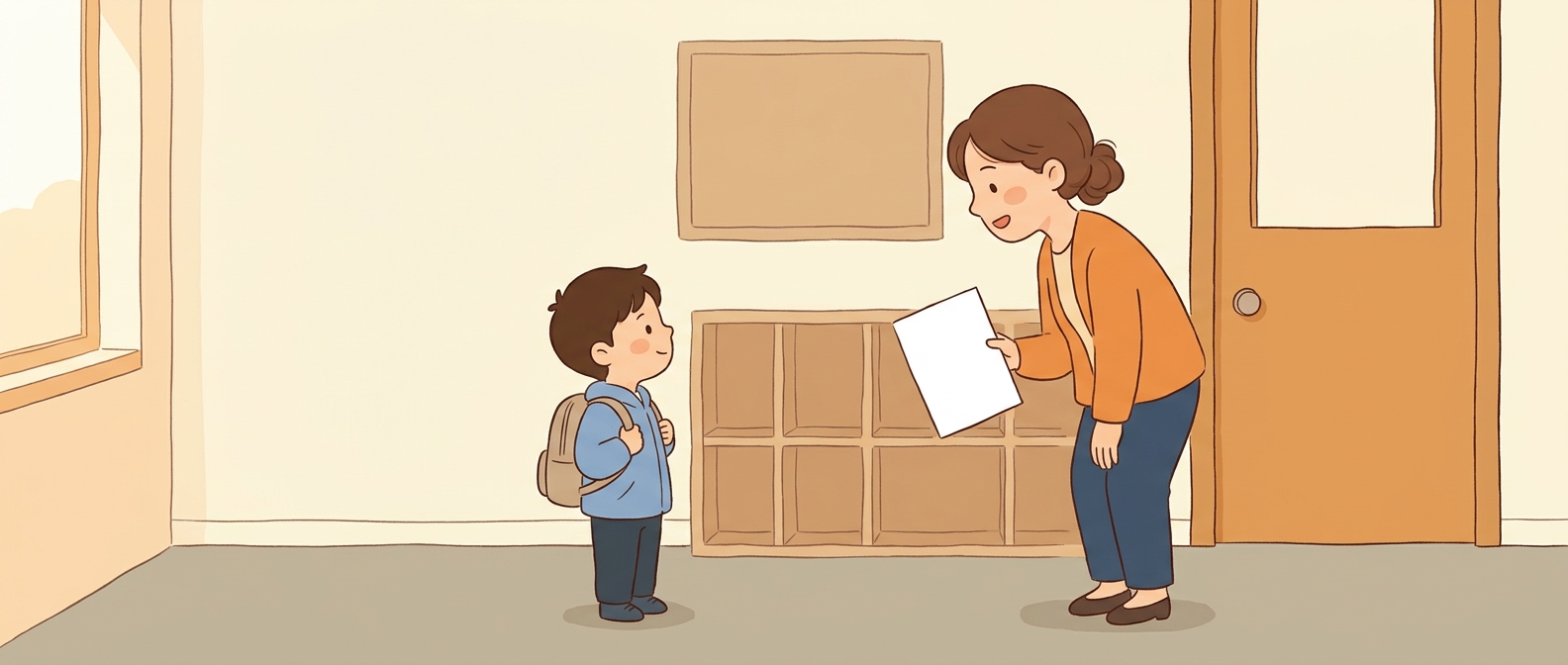
Arriving at a meeting with the school without knowing what to ask can result in vague answers. Here are some specific questions:
- "Does my child receive systematic phonological instruction or is reading primarily taught using global methods?"
- "Does the teacher supporting them have specific training in structured phonetic teaching?"
- "Is phonological awareness being worked on explicitly (identifying sounds, rhyming, segmenting syllables)?"
- "Is there monitoring of their progress in reading fluency and comprehension, not just letter naming?"
If the answer to several of these questions is no or "we don't know," you can request a meeting with the support team to assess whether a specific support plan is needed. You can find more clues about when to request an assessment in Signs of dyslexia by age: what to look for and when to consult.
What to Do Right Now
- Observe without alarming. If your child confuses letters or struggles to connect sound and letter, write it down: those notes will serve you for the conversation with the teacher.
- Request a meeting with the teacher. Ask how they work on reading in class and whether there's specific support in phonological awareness.
- If you don't get a clear answer, request a meeting with the support team. You can say: "I believe my child needs more structured teaching of the relationship between letters and sounds. Can you assess whether a specific support plan is needed?"
- In the meantime, read rhyming texts with them and play games to identify initial sounds. It's not a treatment, but it is a way to work on phonological awareness in a playful way.
Remember that the signs you observe at home or in class are not enough on their own to diagnose a learning difficulty: only a professional can do that, according to the NICHD. What you can do is ask, request, and support.
If you want to prepare for the next conversation with the school, in How to talk to the school about accommodations you'll find practical guidance.
This article is informative and does not replace a professional assessment. If you persistently detect difficulties in reading, writing, or math for your child, the first step is to speak with the school's support team or their primary professional.