
Activities for children with dyslexia: a practical guide by age
If you're here, you're probably looking for something very specific: activities for children with dyslexia that can genuinely be done at home, without needing clinical materials or any special training. That's exactly what we're going to give you: what dyslexia is explained without jargon, common signs for context (without diagnosing anything), and 8 concrete activities organized by age, with reading and writing exercises for dyslexia that you can start today.
What this guide covers
What dyslexia is, explained calmly
Dyslexia is a specific learning difficulty that mainly affects the way the brain processes written language: linking letters to sounds, reading fluently or writing without transposing syllables. It has nothing to do with the child's intelligence or how hard they try: it's a difference in how their brain decodes text, and with the right support it can be trained and compensated for very well.
It's also more common than many people think. According to data published in 2025 in The Lancet Regional Health – Europe, around 7.1% of primary-school children have dyslexia, and the figure keeps rising across Europe. If your child or pupil struggles with reading, you're not the only family looking for answers this week.
Common signs (this is not a diagnosis)
First of all: this list is only a guide, so you know what we usually mean when we talk about dyslexia. It is not a diagnostic tool and no child has to show all of these signs to have dyslexia, nor does showing one necessarily mean they have it.
- They find it harder than expected for their age to link letters to their sounds, even with lots of revision.
- They confuse similarly shaped letters, such as b/d or p/q, beyond the first years of school.
- They read slowly, with visible effort, even though they understand well what is read aloud to them.
- They get tired or frustrated especially quickly during reading tasks, compared with other subjects.
- They write transposing syllables or changing the order of letters within a word.
If several of these signs feel familiar and persist over time, the most useful thing is not to look for more lists online, but to talk to your child's teacher and, if appropriate, a professional (paediatrician, educational psychologist or speech and language therapist) who can assess the specific case.
8 activities to do at home, by age
These are support and reinforcement activities, designed to practise at home for 10 to 20 minutes, without needing special materials beyond paper, a pencil and a little shared patience.
Ages 5 to 6: first sounds and strokes
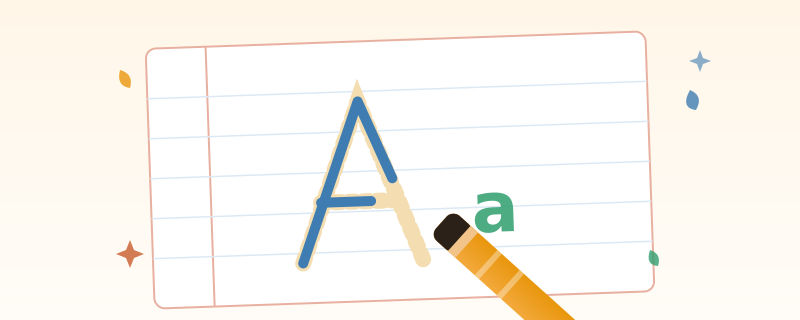
1. Trace the letter with your finger before writing it. Draw the letter large on a sheet of paper and ask the child to trace it with their finger several times, saying the sound aloud as they trace. The body movement helps fix the shape better than copying it straight away with the pencil.
2. "Sound hunt" around the house. Choose a sound (for example, /m/) and search together for 5 objects in the house that start with that sound. It's reading and writing without pencil or paper, playing with what you already have around you.
Ages 7 to 9: syllables and whole words
3. Complete the missing syllable. Write simple sentences with a gap ("The __ppy__ is on the mat") and several similar syllables to choose from. This kind of reading and writing exercise trains exactly the sound-syllable association that is harder in dyslexia.
4. Reading in turns, aloud and without a timer. Take turns reading a paragraph each from a short story. Removing time pressure reduces anxiety and lets the child focus on understanding, not on "doing it fast".
Ages 10 to 12: confusing letters and fluency
5. Tell mirror letters apart by their shape, not their sound. With b/d/p/q, instead of repeating the sound, ask them to colour in one colour the ones that "look" to the right and another colour the ones that "look" to the left. Working by visual shape, not phonetics, helps fix the difference better.
6. Timed reading only against themselves. Time the reading of a short text once a week and note the time, comparing only with their own previous marks, never with other children. The goal is to see their own progress, not to compete.
Ages 13 to 14: comprehension and personal strategies
7. Underline long syllables before reading aloud. In secondary-school texts, letting them mark with a pencil the syllables of long words before reading them helps anticipate the pronunciation and reduces effort during fluent reading.
8. Summarize in their own words, spoken before written. Ask them to say aloud what the text was about before writing anything. Separating comprehension from writing prevents the difficulty of writing from "hiding" how well they did understand the content.
A tip that applies at any age: whatever the age, short and frequent sessions (10-15 minutes, several times a week) work much better than one long, occasional session. Dyslexia is trained with kind consistency, not with the odd burst of intensity.
Why typography and format matter so much
A detail many families don't expect: the format of the material changes the result almost as much as the content does. Very decorative fonts, letters that are too close together or lines that are too long force the eye to make an extra effort that, in a child with dyslexia, uses up a large part of their energy before they even start the activity.
That's why at Zubibook we use Atkinson Hyperlegible, a typeface designed specifically to maximize the difference between similar letters (like I, l and 1), with generous spacing and no flourishes. It's not an aesthetic choice: it's a functional one, so the child's energy goes into reading, not into deciphering the letters.
Generic vs. personalized: why the result changes
Searching for "activities for children with dyslexia" online returns thousands of free PDFs. Many are useful, but almost all share the same problem: they're designed for "children with dyslexia" in general, not for your 8-year-old who is also learning in a bilingual school, or for your clinic pupil who already masters simple syllables and needs a step further.
The difference between generic material and one personalized by age, specific difficulty and language is, in practice, the difference between an activity that hooks a child and one that's abandoned by the second page. A workbook adjusted to the exact level avoids both frustration (if it's too hard) and boredom (if it's too easy) — and that's precisely what we aim to automate at Zubibook.
This article offers general information and support activities. Zubibook is not a healthcare provider or an accredited educational institution: it does not replace the diagnosis or follow-up of a professional. If you have any doubt about a child's development, consult a specialist.
Remember: the activities in this guide are for general reinforcement. They do not replace the assessment of a speech and language therapist, educational psychologist or paediatrician, who is the one who can guide the specific case of your child or pupil.
Next step: a workbook made for that specific child
If you found these activities useful, the natural next step is to have a complete workbook that combines several of them, already adjusted to the age, language and exact level of your child or pupil — without having to design it yourself from scratch every week. At Zubibook you can generate one in minutes and download it as a print-ready PDF.
Create a dyslexia workbook tailored to your child
Choose age, difficulty and language and generate a print-ready PDF activity workbook in minutes.