Printable ADHD exercises that really work
When a family searches for printable ADHD exercises, they're almost never just looking for "more worksheets": they're looking for something that genuinely helps their child focus a little longer and get through each afternoon's homework with less frustration. In this guide we look at which types of exercises really work (sustained attention, self-regulation, visual planning), why the typical "free printable" sometimes falls short, and how to choose better.
What this guide covers
What a family with ADHD is really looking for
Behind a search for "attention and concentration worksheets" there's almost always a very specific scene: homework that drags on for an hour instead of twenty minutes, the child who gets up from the chair eight times, or the feeling of improvising material every week. The goal isn't to "entertain" the child; it's to find a clear structure that helps them hold their attention a little longer and feel that they can cope with the task.
According to 2025 data published in The Lancet Regional Health – Europe, around 2.9% of children have a diagnosis of ADHD, and that figure is also rising. Many families, moreover, combine ADHD with other difficulties (such as dyslexia), which makes it even harder to find material that fits that specific profile well.
Types of exercises that work
Sustained attention
Short mazes and "spot the difference". Exercises of 2 to 5 minutes where the child follows a path or locates specific items train sustained attention without exhausting it: the key is that they're brief and have a clear ending, not that they're very long.
"Symbol hunt" in a grid. Searching for and marking one specific symbol among several similar ones, with a gentle time limit, is a classic selective-attention exercise that can easily be adjusted in difficulty by age.
Self-regulation
"Before and after" tables with emotions. Marking how the child feels before starting a task and how they feel when they finish helps them, over time, recognize their own rhythm and anticipate when they need a break.
The calm traffic light. A simple worksheet with three colours (red: stop and breathe, amber: think of an option, green: act) that the child can point to when they notice they're getting worked up, as visual support to self-regulate without relying solely on an adult's verbal instructions.
Visual planning
Split-and-tick a long task into short steps. A task that looks huge (for example, "study unit 5") turns into 3-4 concrete boxes to tick ("read pages 1-2", "write a summary", "revise out loud"). Seeing the progress ticked off greatly reduces that initial sense of being stuck.
Weekly visual planner with limited space. A simple calendar where only 2-3 tasks fit per day forces prioritizing and avoids the endless list that a child with ADHD tends to abandon at the very first line.
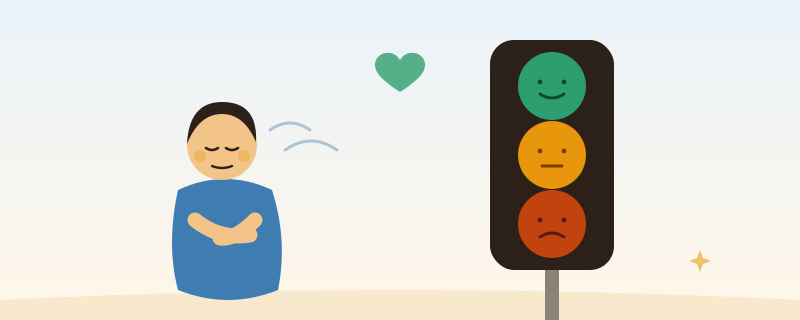
A tip that applies across the board: what works best isn't an isolated exercise, but the same structure repeated every day (same format, same type of task at the start) so the child knows what to expect and doesn't have to "decode" the exercise itself as well.
Why a "free printable" sometimes isn't enough
The free workbooks you find by searching for "free ADHD workbook" are usually technically correct, but they share a clear limitation: they're designed for a broad, generic age range ("primary school", "ages 6-12"), not for the real attention level of your specific 9-year-old. The usual result is that the first page works well and the third is left half-done, because the jump in difficulty wasn't designed with them in mind.
What's more, very few free printables combine two variables well at once, such as ADHD together with a reading difficulty, or the language actually spoken at home. That's where generic material, even if it's free, ends up costing more time than it saves: you have to search, filter and adapt by hand.
An honest comparison: free-generic vs. personalized
🗂️ Free generic workbook
- Broad age range, not your exact age
- Same difficulty level for everyone
- Usually only in one fixed language
- You have to search, download and filter several sources
- Free, but with a cost in time
🎯 Personalized workbook
- Adjusted to the child's exact age
- Difficulty level calibrated to their profile
- Available in the family's real language
- Ready in minutes, with no searching or filtering
- Low cost (from €14) in exchange for time and fine-tuning
Neither option is "bad": if you have the time and the will to search, a good free printable can work perfectly well as a first step. But if what you need is something already adjusted to your child, without spending an afternoon searching and adapting, a personalized workbook like the ones from Zubibook usually saves exactly that part.
This article offers general information and support activities. Zubibook is not a healthcare provider or an accredited educational institution: it does not replace the diagnosis or follow-up of a professional. If you have any doubt about a child's development, consult a specialist.
Remember: these exercises are for general reinforcement and support. They do not replace the assessment of a healthcare or education professional, who is the one who can guide the specific case of your child or pupil.
Next step: a workbook adjusted to their pace
If you want to go a step beyond loose worksheets, at Zubibook you can generate a complete workbook combining attention, self-regulation and visual planning, adjusted to the age, language and exact level of your child, ready to print in minutes.
Create an ADHD workbook tailored to your child
Choose age, difficulty and language and generate a print-ready PDF activity workbook in minutes.