Dyscalculia: signs by age from 4 to 12, and when to ask for an assessment
We have a fairly clear idea of what is normal with reading at each age. With numbers, much less so. Many families reach dyscalculia by elimination, after years of "maths just isn't their thing", of times tables repeated every night and of a child who wants less and less to do with homework. This guide is about exactly that: which signs belong to which age, which ones are normal, and when it is worth asking for an assessment.
What dyscalculia is, in two sentences
It is a specific learning difficulty that affects number sense: understanding quantities, comparing them, working with them and remembering number facts. The DSM-5 lists it as a specific learning disorder with impairment in mathematics. Depending on the study, it affects between 3 and 6 per cent of children, roughly one per class, and it often comes together with dyslexia or ADHD.
It has nothing to do with intelligence or effort. A child with dyscalculia can reason through a problem perfectly well and still not know whether 7 is more than 5 without stopping to think.

Signs by age
What matters is not one sign on its own, but several of them repeating for months and not improving with normal practice.
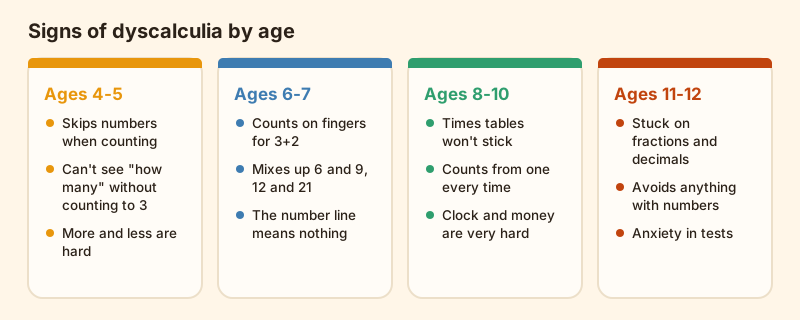
Ages 4 and 5 (early years)
- Skips numbers when counting from memory, or gets them out of order, past the age when classmates can already recite to ten or twenty.
- Can't "see" small quantities at a glance. To know there are three biscuits, counts them one by one.
- Finds it hard to say where there is more or less, even when the difference is obvious.
- When counting objects, points at one and says two numbers, or points at two and says one.
At this age all of this can simply be a matter of pace. It becomes a sign if it persists at the end of the early years and the rest of language development is on track.
Ages 6 and 7 (first years of primary)
- Still counts on fingers for very small sums (3+2) when classmates already know them by heart.
- Regularly mixes up similar symbols (6 and 9) and the order of digits (12 and 21).
- Doesn't understand the number line: can't place 5 roughly where it goes between 0 and 10.
- Learns a method one day and it has vanished the next.
- Tens and units are a mystery: 23 is "a two and a three".
Ages 8 to 10
- Times tables won't stick however often they are repeated, and the ones that do are recalled very slowly.
- To work out 8+5, goes back to counting from one.
- The analogue clock, money and measurements are especially difficult.
- Finds it hard to estimate: ask roughly how much 48+51 is and they have no idea where to start.
- Understands the story in a word problem but not which operation it needs.
Ages 11 to 12 (end of primary)
- Fractions, decimals and percentages are a wall, not a next step.
- Avoids any task involving numbers, including everyday life: doesn't want to pay in a shop, doesn't work out how long is left until something.
- Anxiety appears in maths tests, sometimes with tummy aches or headaches.
- Mental arithmetic with simple things is still slow, even though reasoning in other areas is good.

What often gets mistaken for dyscalculia
Before worrying, it is worth ruling out three things:
A foundation that was never laid. A change of school, a year with lots of absences or very mechanical teaching leave gaps that look like dyscalculia and close with explicit teaching.
Attention problems. A child with ADHD makes calculation mistakes through lapses, not because they don't understand quantities. Give them time and a quiet setting and they get it right. With dyscalculia, time doesn't fix it.
Maths anxiety on its own. It is real and it blocks, but it usually starts later and responds well when the pressure is taken off. That said, dyscalculia without support almost always ends up causing anxiety, so the two can go together.
When to ask for an assessment
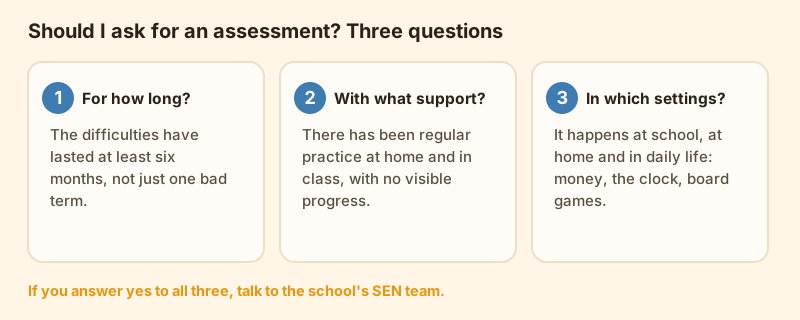
If the difficulties have lasted at least six months, there has been regular practice at home and in class with little or no progress, and they also show up outside school (money, the clock, board games), it is time to talk to the class teacher and ask the school's special educational needs coordinator for an assessment. Depending on where you live, the school can arrange it, or it is quicker to see an educational psychologist privately and bring the report to school.
A diagnosis is not a label for life: it is the door to reasonable adjustments (extra time, a calculator, visual supports, not penalising calculation slips in a well-reasoned problem) and to support that does work when it is explicit, hands-on and consistent.
Meanwhile, at home
You don't need to wait for the report to start. Short sessions, with objects you can touch and no rush, do more than a worksheet full of sums. We have a guide to dyscalculia exercises at home with ten-minute games, and another on how to talk to the school about adjustments.
And one piece of advice we repeat a lot: write down what you see. What was hard, what went well, how long it took. A planner where your child notes their own homework and small wins is also the best record to take to the meeting with the school, because it turns "maths isn't their thing" into something concrete and dated.